Google is one of the world’s most famous tech giants. A few years ago, it was seen as a top destination with great benefits and relatively low pressure. In London, Google has a primary office focused on development and research.
First Interview in 2016
My first Google interview was in 2016. It started with a phone interview led by an engineer from Switzerland. We discussed via phone while coding together in Google Docs. Due to my limited technical skills back then, I used C++ to complete the problem, which involved using queues and hash tables for message printing, and my solution was quite rough.
At the time, I didn’t have a clear idea of engineering levels, but I assumed I was aiming for SWE L4/L5, as I had about five years of experience.
I checked my emails; back in November 2013, a Google recruiter reached out asking if I’d like to try for an interview. Since I didn’t yet have permanent residency in the UK, I didn’t want to take a risk, even though he mentioned that Google could sponsor a work visa. Reflecting now, I think it was an incredible opportunity missed. In 2014/2015, the same recruiter kept in touch, checking in every six months until we finally set up the first interview in April 2016.
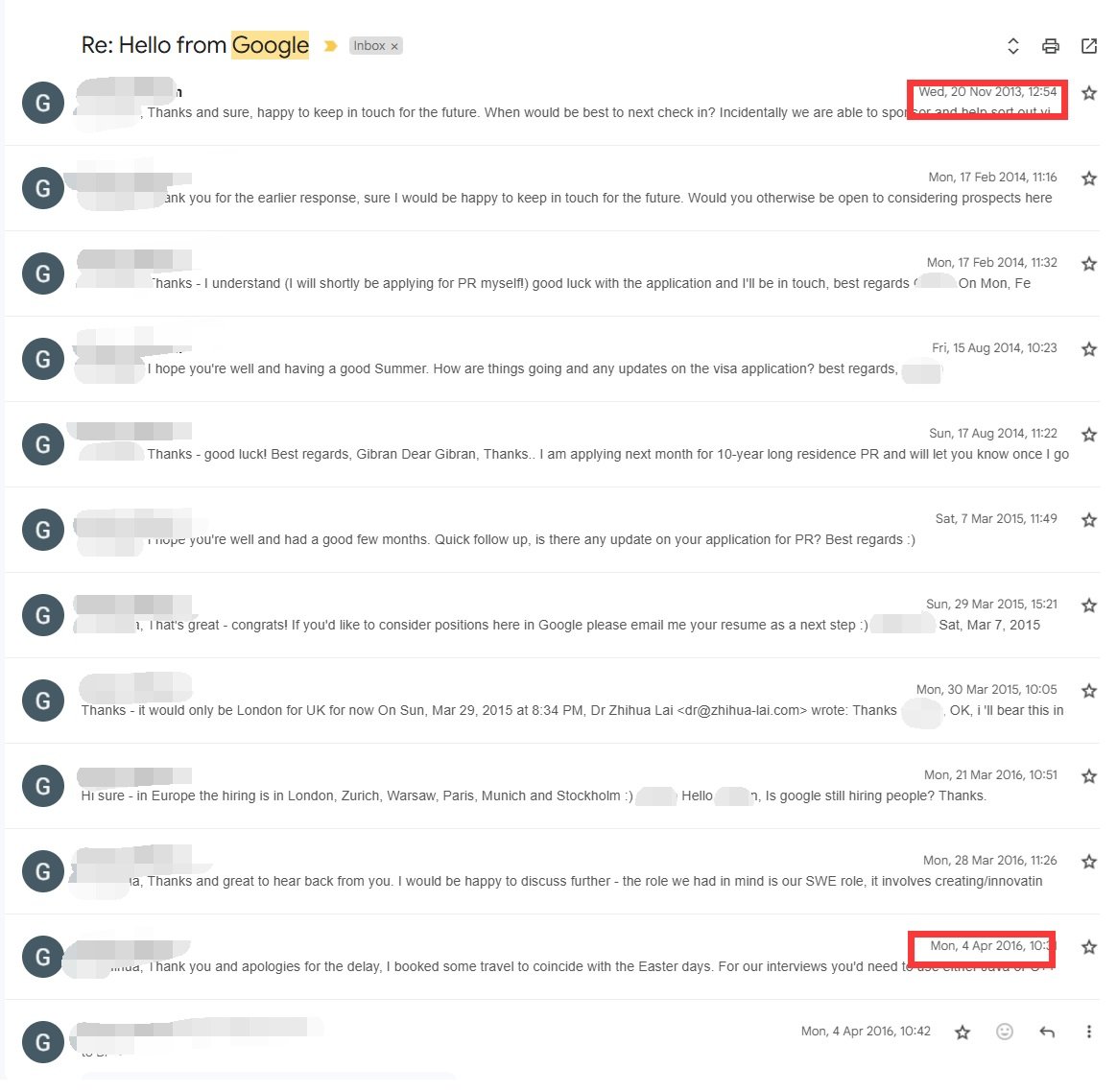
This Google recruiter was very persistent, initially contacting me in 2014 and following up for three years until I joined the first interview round.
If I had been more prepared back then and practiced coding questions, I might have made it into Google and accumulated nearly a decade of experiences.
Second Interview in 2020
The second interview came in November 2020. The preliminary round was a chat with the recruiter, covering questions like “What happens in C++ when you access a non-existent key in a hash map?” For Google’s engineering positions, both SWE and SRE applicants can choose between a data structures and algorithms focus or a DevOps/operations focus, leaning toward Linux knowledge. I chose the former, feeling it was easier to prepare in the short term.
After passing the recruiter’s mini-test, I moved to the first round, which involved solving a 45-minute coding challenge – for example, Generate a Random Maze algorithm. You’re expected to take the lead, clarifying the problem, designing a solution, coding, and discussing complexities, all while thinking out loud. Despite some errors, the feedback was positive, and the interviewer felt I should proceed to the next round.
The final interview was scheduled on the same day, with two rounds in the morning and three in the afternoon: three coding rounds, one system design, and one culture/behavioral fit. Coding rounds required solving one problem each, which was challenging. System design involved designing an AWS S3-like storage system. Unfortunately, I didn’t pass this last round at the L5 (Senior) level; the higher the level, the greater the expectations for system design skills.
For Google, the coding round’s more difficult than Meta. Google’s coding question has a larger scope, and usually involves lots of follow-up questions e.g optimize the algorithm, while the Meta almost 100% asks the same questions from Leetcode. The Meta/Facebook Interviewers would paste two leetcode questions into the coding editor. You would be expected to solve 2 leetcode questions during 40 minutes, leaving about 5 minutes for questions.
Google doesn’t disclose specific feedback per interview session, however, they told me that my System Design interview didn’t pass the minimal required score.
Unfortunately Google doesn’t disclose specific feedback per interview session so in this case I can’t share more context. I wish I had more to share with you!
Also, we don’t use the scoring system from 1-4 anymore, each person puts in full context, notes, and recommendations and then HC reviews for an overall consensus decision.
Large companies don’t usually lower the level to make an offer, so if you apply for L5 but only meet L4 standards, they generally won’t extend an offer. That said, Meta is known to sometimes offer one level lower, like giving an E4 position instead of E5.
Level is determined during the interview process based on your individual background, including a number of factors like CV experience, blended with interview performance, and where this may align across SWE/SRE.
Unfortunately we reviewed for overall technical depth slotted against our teams and right now the decision is not to proceed.
This position was for an SRE/Site Reliability Engineer role.
Third Interview in 2024
In 2023, I applied for a Google Research position in London, but after a brief conversation with the recruiter, I heard nothing further (The recruiter said he would pass my resume to the hiring manager). After a few weeks, I was told the position had already been filled.
Apologies for the radio silence on this one, we have had radio silence from the hiring manager on this role. They have unfortunately decided to prioritise other hiring areas in the team so we won’t be able to move forward at this stage.
However, if we have any other roles in the future I will make sure to keep you in mind.
In 2021/2022, I had also applied to positions but didn’t progress (rejected at resume review). I even tried for a role in Google Switzerland, known for high salaries on par with the U.S., but received a rejection the day after applying, from an Engineer working in Google Switzerland.
This year, I applied somewhat casually, but both Meta and Google responded positively. I made it to the initial screen rounds for both, as I had in 2020, when I reached the final onsite rounds at both companies.
The Google recruiter this year skipped the mini-test and let me choose between algorithm-focused or DevOps-focused interviews for the SRE role. The first round involved designing a simplified game and a 45-minute coding session, ending with some follow-up questions on scaling up the game.
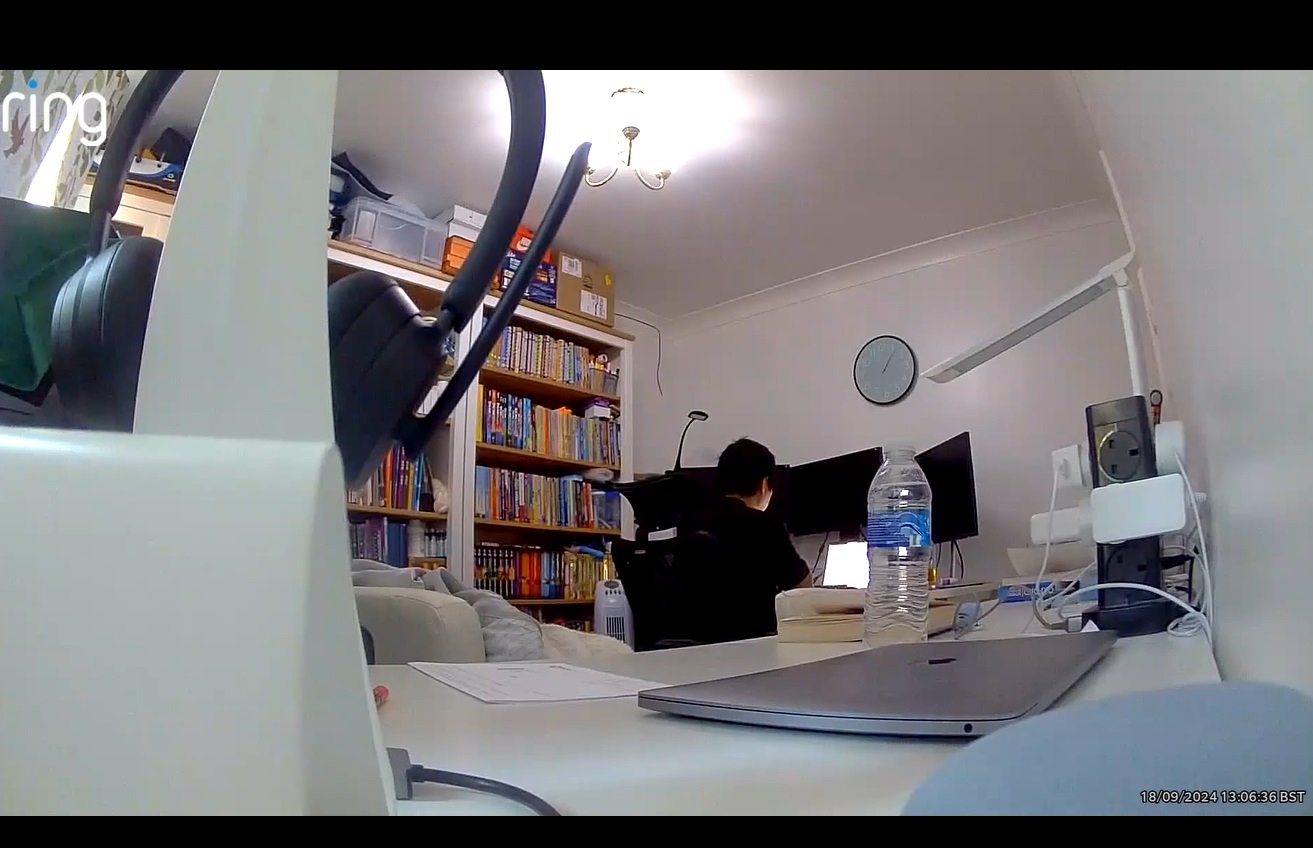
My first Google interview this year was done over a 45-minute lunch break at home, recorded by my Ring camera.
My brute-force solution worked initially, though with minor errors. The interviewer pointed out two small mistakes that I corrected quickly, later optimizing with binary search and prefix sums algorithm. The interviewer was impressed by my approach, though we only discussed segment trees due to time constraints, without full implementation.
After two weeks, I received another update from the recruiter:
I hope you’re keeping well, I just wanted to update you that we have now closed our London role. If we get another one through we will definitely be in touch! Thank you so much for everything you invested in our interviews, I know you put in a lot, on top of everything else and elsewhere too – and I know it takes a lot, so really do appreciate it, and I really hope we can keep in touch and work together again in the not so distant future! Take care and thank you again for everything you invested in our process, I really enjoyed working with you and getting to know you.
I wish you every strength, take care XXX!
I’ve replied:
Could I apply to other roles if there are any suitable in the meantime? Or is it better to just wait?
And a few days later, I got the response from the Google Recruiter:
I hope you’re keeping well! Thank you for your patience, we should have some roles coming live in London so I’ll catch up with you super soon! Good news!
Update: the Google Recruiter contacted me approaching the Christmas 2024, and rescheduled the final rounds of interviews. This also indicates that my first round interview wasn’t a complete failure. At least, it hit the minimal bar, it was not good enough (to beat other application).
Update: The two coding rounds felt okay. It seems like Google really likes to test the Segment Tree data structure. The cultural fit assessment was strange—there were only three questions before it ended, and the interviewer was even five minutes late. It didn’t take long (roughly about 15 mins) for 3 questions to answer. I asked some questions at the end and my WIFI router was dead for a while but luckily I reconncted to the meeting and the interviewer was still there waiting for me to say goodbye.
The system design round went very poorly. Midway through, I already felt like I had no chance. The key takeaway is to do the calculations. Even though I listed the functional and non-functional requirements, I forgot to check whether the known requirements could fit into memory, which would have impacted the design.
After the interview, Google completely ignored me. Even though I knew I didn’t pass, I still wanted some feedback. I followed up twice, but the recruiter didn’t respond. The interview experience was terrible, nothing like my experience with Meta.

Google Final Interviews
Are There Only Three Chances to Interview at Google in a Lifetime?
There is no strict limit on the number of interview attempts at Google, so it isn’t strictly “three chances in a lifetime.” Google does have a policy of a “cooling-off” period, meaning that if an interview isn’t successful, the candidate must wait before reapplying.
The usual waiting period is six to twelve months, varying by role and situation. If a candidate performed well previously, they may be eligible to reapply sooner. However, the longer the gap, the higher the expectations for growth and improvement, so thorough preparation is essential for subsequent attempts.
Software Engineer Interview Experience
- NVIDIA, I'm Coming Again! This Time I'm Tougher!
- Jane Street First Round Interview Experience (Software Engineer at London)
- Four Facebook (Meta) Interview Experiences
- Three Attempts at Google: My Software Engineer Interview Journey (Is There Only Three Chances in a Lifetime?)
- Two Interview Experience with ByteDance Tiktok London
Interview Tips
- Difference Between Product Design Interview and System Design Interview
- Onsite Interview Tips for Facebook / Google / Microsoft / Amazon / Apple
- 45 Minute Mock Interview (Coding, System Design) + Career Development Advices
- Facebook Interview Tips and Guidance
- Coding Interview Tips for Software Engineers
- What are Big4 Tech Companies looking for in the technical interviews (Phone Screening)?
- How to use the Leetcode's Mock Interview Overview to Nail Your Interview?
- Facebook Onsite Interview Preparation Part 3: How to Ace a Design Interview?
- The Facebook Initial Coding Interview Experience
- Facebook Onsite Interview Preparation Part 2: Coding Questions
- Facebook Onsite Interview Preparation Part 1: Motivation/Bahavior Questions
- A Microsoft Coding Interview Screening for Position Principal Software Engineer
- How to Prepare for an Amazon Interview? My Amazon Interview Experience
- Go to an Interview even if you are not changing your job.
- Last Minute Tips before Phone Interview
Interview Questions
- Interview Coding Exercise - Nested String (Python)
- Some Telephone Interview Questions for C++/C# Software Enginners
- Microsoft Interview Question - Get the Area of the Triangle
- Google Interview Question: Print Messages
Update: Google Finals: Close to L5, Offered L4, and a Big Pie in the Sky
–EOF (The Ultimate Computing & Technology Blog) —
2070 wordsLast Post: How AI and Dynamic Pricing Shape Our Everyday Costs
Next Post: Teaching Kids Programming - Delete Nodes From Linked List Present in Array