The Magik programming language as described in here is a powerful dynamic-typed object-oriented programming language. Currently, it has been used widely at GE Smallworld GIS products. It has been ported to Java VM (Virtual Machine) at 2012.
The FizzBuzz is a good exercise to get familiar with any programming languages, and here we go:
# Write a short program that prints each number from 1 to 100 on a new line.
# For each multiple of 3, print “Fizz” instead of the number.
# For each multiple of 5, print “Buzz” instead of the number.
# For numbers which are multiples of both 3 and 5, print “FizzBuzz” instead of the number.
# I love Magik!
_package sw;
$

_block
    _for i _over range(1, 100)
    _loop
        _local div3? << i _mod 3 = 0
        _local div5? << i _mod 5 = 0
        _if div3? _andif div5? _then
            write("FizzBuzz")
        _elif div3? _then
            write("Fizz")
        _elif div5? _then
            write("Buzz")
        _else
            write(i)
        _endif
    _endloop
_endblock
Start a Magik session, then Compile in Visual Studio Code using Ctrl+F7 shortcut (the Magik-VS-code extension) and you should see the results printing out to the console correctly.
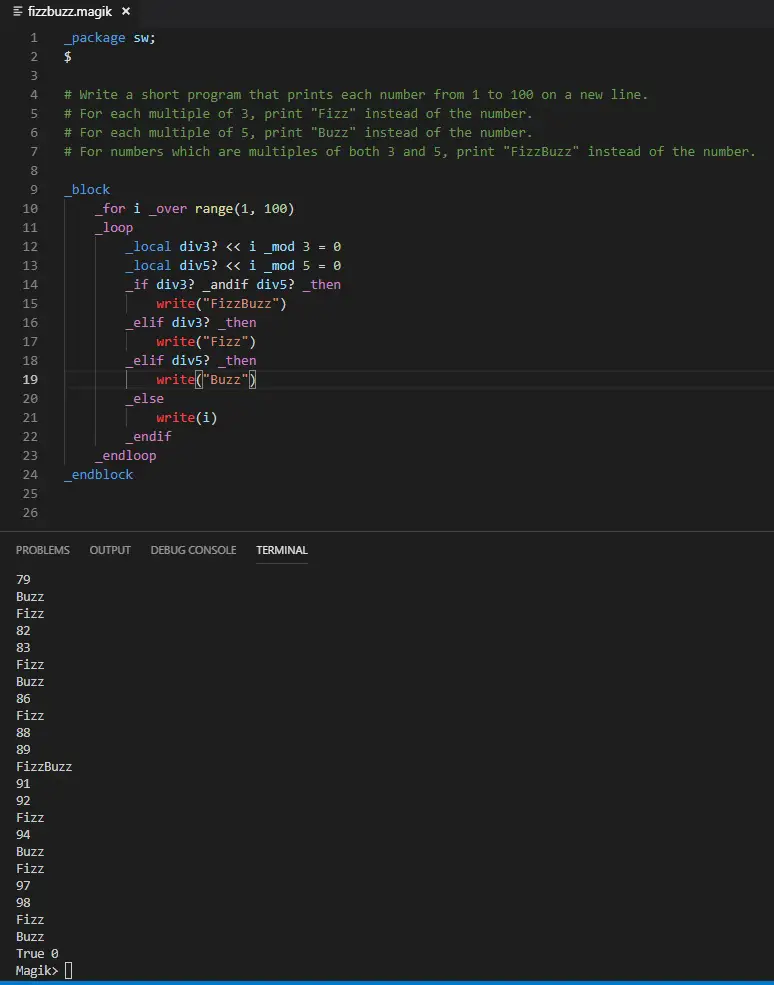
fizzbuzz-magik-exercise
FizzBuzz:
- Sexy One-liner of Python to Solve the FizzBuzz
- How to For-Loop and do Math/Arithmetic Operations in Windows/NT Batch – the FizzBuzz Programming Example
- The FizzBuzz Example in Magik Programming Language
- GoLang: FizzBuzz
–EOF (The Ultimate Computing & Technology Blog) —
Last Post: How to Fix "Unsafe cannot be resolved to a type" in Eclipse/Java?
Next Post: Determine a Univalue Binary Tree via Recursive Depth First Search Algorithms