
Teaching Kids Programming: Videos on Data Structures and Algorithms

Shortest Path on Undirected Graphs: DFS or BFS?
The Depth First Search and Breadth First Search algorithms can be both used to traverse a Graph (including trees). The BFS uses a queue and we can guarantee the shortest path once a node is visited as we traverse the paths in the level-by-level order. The Python code for BFS a Graph is as follows where we need to use a hash set to remember the nodes that have been pushed to the queue (visited). We use deque to have O(1) constant pop operation of the queue.
def BFS(G, src):
    q = deque([src])
    seen = set()
    while q:
        cur = q.popleft()
        visit(cur)     # visiting node cur
        for n in G[cur]:
            if n not in seen:
                seen.add(n)
                q.append(n)
If we want to find a shortest path between src and target (stop when we hit target):
def BFS(G, src, target):
    q = deque([src])
    seen = set()
    while q:
        cur = q.popleft()
        visit(cur)     # visiting node cur
        if cur == target:
            return True
        for n in G[cur]:
            if n not in seen:
                seen.add(n)
                q.append(n)
    return False
The Depth First Search Algorithm uses a stack – which usually is implemented by Recursion. The Python code for traversing a Graph using a DFS is:
def dfs(G, src, seen):
    if src in seen:
        return
    visit(src)     # visiting node src
    seen.add(src)
    for n in G[src]:
        dfs(G, n, seen):
And, if we want to stop after we find the target:
def dfs(G, src, seen, target):
    if src in seen:
        return False
    if src == target:
        return True
    visit(src)     # visiting node src
    seen.add(src)
    for n in G[src]:
        if dfs(G, n, seen):
            return True
    return False
Is BFS with Stack DFS?
If we use stack instead of queue in BFS – does it become a DFS? considering the following modified BFS (with stack instead):
def BFS(G, src):
    q = [src] # list - used as the stack
    seen = set()
    while q:
        cur = q.pop()
        visit(cur)     # visiting node cur
        for n in G[cur]:
            if n not in seen:
                seen.add(n)
                q.append(n)
And considering the following Simple Graph aka a Graph with no multiple edges and no loops – and if we start with vertex A:
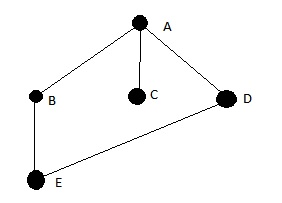
A simple graph with five vertex ABCDE
For BFS, we have traversal order: ABCDE (level by level). For DFS: we have ABEDC. But with BFS that is implemented using stack – we have ABECD (there is a difference in marking a node visited when pushing or being visited).
Therefore, a Breadth First Search that is implemented with stack is not equivalent to a Depth First Search Algorithm.
Can DFS guarantee a shortest Path?
No in general unless we use DFS to exhaustive all the search paths. Considering the following simple graph (a Triangle):
    A
   / \
  B---C
The shortest path from A to B is AB however with DFS, the first path is ACB.
Iterative Deepening Search Algorithm
The Iterative Deepening Search (IDS) is based on DFS however it guarantees a shortest path. Let’s take a look:
def dfs(G, src, target, seen, depth, maxDepth):
    if src in seen:
        return False
    # only difference than a DFS
    if depth > maxDepth:
        return False
    if src == target:
        return True
    seen.add(src)
    for n in G[src]:
        dfs(G, n, seen, depth + 1, maxDepth)
We add depth parameters so that we can stop search when the search distance exceeds a threshold. And we start with depth 1 and increment the distance until the target is found:
def ids(G, src, target):
   found = False
   while not found:
       seen = set()
       depth += 1
       found = dfs(G, src, target, seen, 0, depth)
Let’s consider this simple Graph again.
    A
   / \
  B---C
When depth is one, we can only find the paths A-C and A-B. We stop at C when doing DFS at max depth 1. Thus, this approach Iterative Deepening Search guarantees the shortest path.
IDS uses linear space complexity for some graphs considering a Full Binary Tree where the BFS need to use exponential 


Shortest Path Algorithms
- Teaching Kids Programming – Distance Between Bus Stops (Floyd Warshal Shortest Path in Simple Undirected Weighted Regular Graph)
- Teaching Kids Programming – Depth First/Limit Search and Iterative Deepening Search Algorithm on Unweighted Graph
- Teaching Kids Programming – A Light Talk on Breadth First Search, Uniform Cost Search and Dijkstra Shortest Path Graph Algorithms
- Teaching Kids Programming – Introduction to Dijkstra Single Source Shortest Path Graph Algorithm
- Teaching Kids Programming – Single Source Shortest Path Algorithm in a Directed Unweighted Graph using Breadth First Search
- Teaching Kids Programming – Floyd Warshal Multi-source/All Pairs Shortest Path Algorithm (Sum of Costs in a Directed Unweighted Graph)
- Teaching Kids Programming – Uniform Cost Search Algorithm to Solve Single-Source Shortest Path in a Graph
- Teaching Kids Programming – Shortest Path Algorithms by Iterative Deepening Search (IDS), Depth First Search (DFS) or Breadth First Search (BFS) on Undirected Graphs
- Teaching Kids Programming – Finding the Network Delay Time via Floyd-Warshall Shortest Path Algorithm
- Teaching Kids Programming – Distance Between Bus Stops (Shortest Distance in Simple Undirected Weighted Regular Graph)
–EOF (The Ultimate Computing & Technology Blog) —
Last Post: Teaching Kids Programming - Max Profit of Rod Cutting (Unbounded Knapsack) via Bottom Up Dynamic Programming Algorithm
Next Post: Teaching Kids Programming - Multiple Strange Coin Flips/Toss Top Down Dynamic Programming Algorithm (Knapsack Variant)