Teaching Kids Programming: Videos on Data Structures and Algorithms

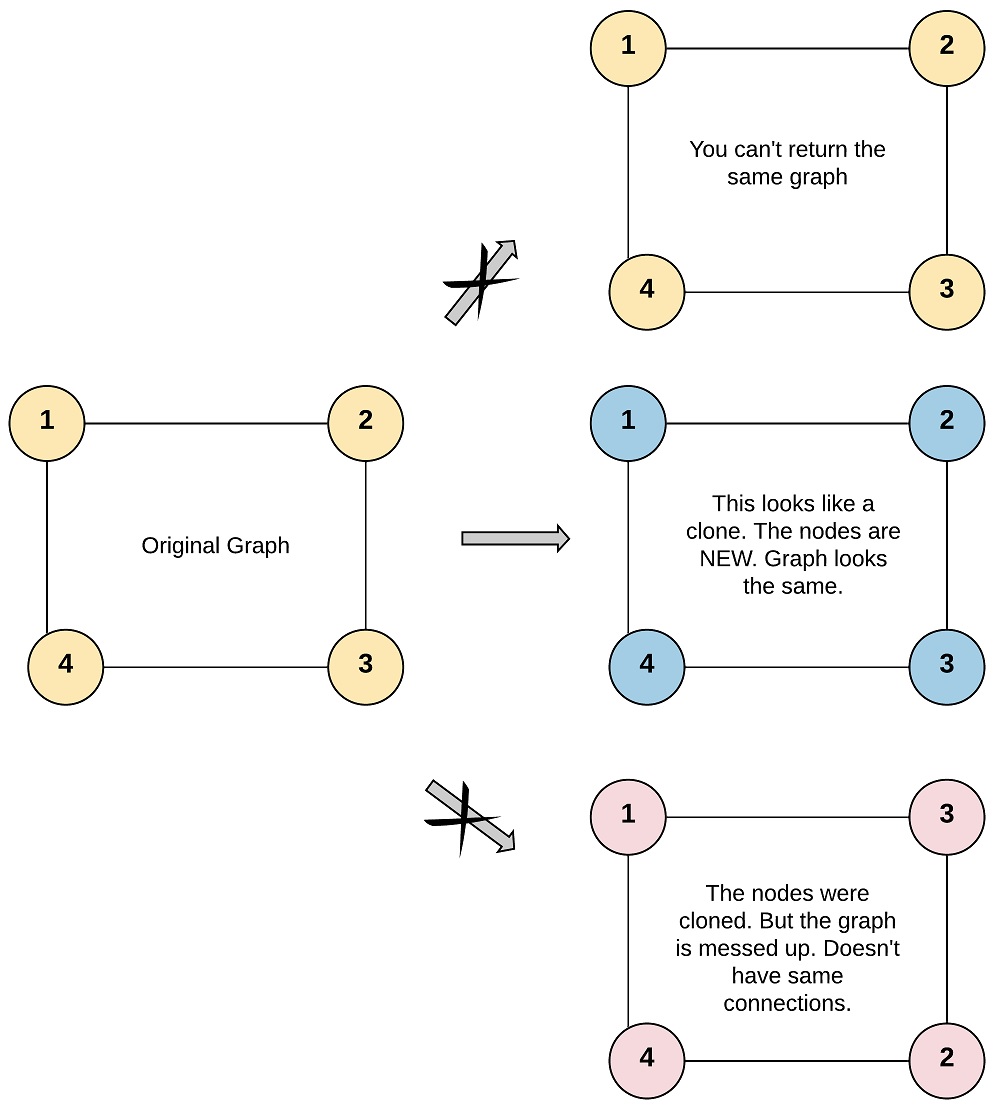
Given a reference of a node in a connected undirected graph. Return a deep copy (clone) of the graph.
Each node in the graph contains a value (int) and a list (List[Node]) of its neighbors.
class Node {
    public int val;
    public List<Node> neighbors;
}
Test case format:
For simplicity, each node’s value is the same as the node’s index (1-indexed). For example, the first node with val == 1, the second node with val == 2, and so on. The graph is represented in the test case using an adjacency list.
An adjacency list is a collection of unordered lists used to represent a finite graph. Each list describes the set of neighbors of a node in the graph.
The given node will always be the first node with val = 1. You must return the copy of the given node as a reference to the cloned graph.Clone a Graph
Example 1:
Input: adjList = [[2,4],[1,3],[2,4],[1,3]]
Output: [[2,4],[1,3],[2,4],[1,3]]
Explanation: There are 4 nodes in the graph.
1st node (val = 1)’s neighbors are 2nd node (val = 2) and 4th node (val = 4).
2nd node (val = 2)’s neighbors are 1st node (val = 1) and 3rd node (val = 3).
3rd node (val = 3)’s neighbors are 2nd node (val = 2) and 4th node (val = 4).
4th node (val = 4)’s neighbors are 1st node (val = 1) and 3rd node (val = 3).Example 2:
Input: adjList = [[]]
Output: [[]]
Explanation: Note that the input contains one empty list. The graph consists of only one node with val = 1 and it does not have any neighbors.Example 3:
Input: adjList = []
Output: []
Explanation: This an empty graph, it does not have any nodes.Constraints:
The number of nodes in the graph is in the range [0, 100].
1 <= Node.val <= 100
Node.val is unique for each node.
There are no repeated edges and no self-loops in the graph.
The Graph is connected and all nodes can be visited starting from the given node.
Clone a Graph using Breadth First Search Algorithm
A Graph is a collections of vertices and edges and can be noted as 

Apart from Depth First Search Algorithm, we can use Breadth First Search Algorithm to traverse a Graph. And we can clone/copy a Node while we are visiting a Node in the first time, and also we need to copy the edge i.e. add the neighbour nodes to the current nodes’ neighbour list.
We use a queue to implement a Breadth First Search Algorithm.
"""
# Definition for a Node.
class Node(object):
    def __init__(self, val, neighbors):
        self.val = val
        self.neighbors = neighbors
"""
class Solution(object):
    def cloneGraph(self, node):
        if not node:
            return node
        q = deque([node])
        seen = {}
        seen[node] = Node(node.val, [])
        while q:
            cur = q.popleft()
            for n in cur.neighbors:
                if n not in seen:
                    seen[n] = Node(n.val, [])
                    q.append(n)
                seen[cur].neighbors.append(seen[n])
        return seen[node]
The time complexity is O(N+M) where N is the number of the vertices in the Graph, and M is the number of the edges. This is the same as: Teaching Kids Programming – Clone (Deep Copy) a Undirected Connected Graph using Recursive Depth First Search Algorithm. The space complexity is O(N) as we are using a queue to store the graph vertices/nodes.
–EOF (The Ultimate Computing & Technology Blog) —
Last Post: Teaching Kids Programming - Clone (Deep Copy) a Undirected Connected Graph using Recursive Depth First Search Algorithm
Next Post: Teaching Kids Programming - Sort Even and Odd Indices Independently (Merge and Sort Algorithm)