Given an integer number n, return the difference between the product of its digits and the sum of its digits.
Example 1:
Input: n = 234
Output: 15
Explanation:
Product of digits = 2 * 3 * 4 = 24
Sum of digits = 2 + 3 + 4 = 9
Result = 24 – 9 = 15Example 2:
Input: n = 4421
Output: 21
Explanation:
Product of digits = 4 * 4 * 2 * 1 = 32
Sum of digits = 4 + 4 + 2 + 1 = 11
Result = 32 – 11 = 21Constraints:
1 <= n <= 10^5Hints:
How to compute all digits of the number?
Use modulus operator (%) to compute the last digit.
Generalise modulus operator idea to compute all digits.
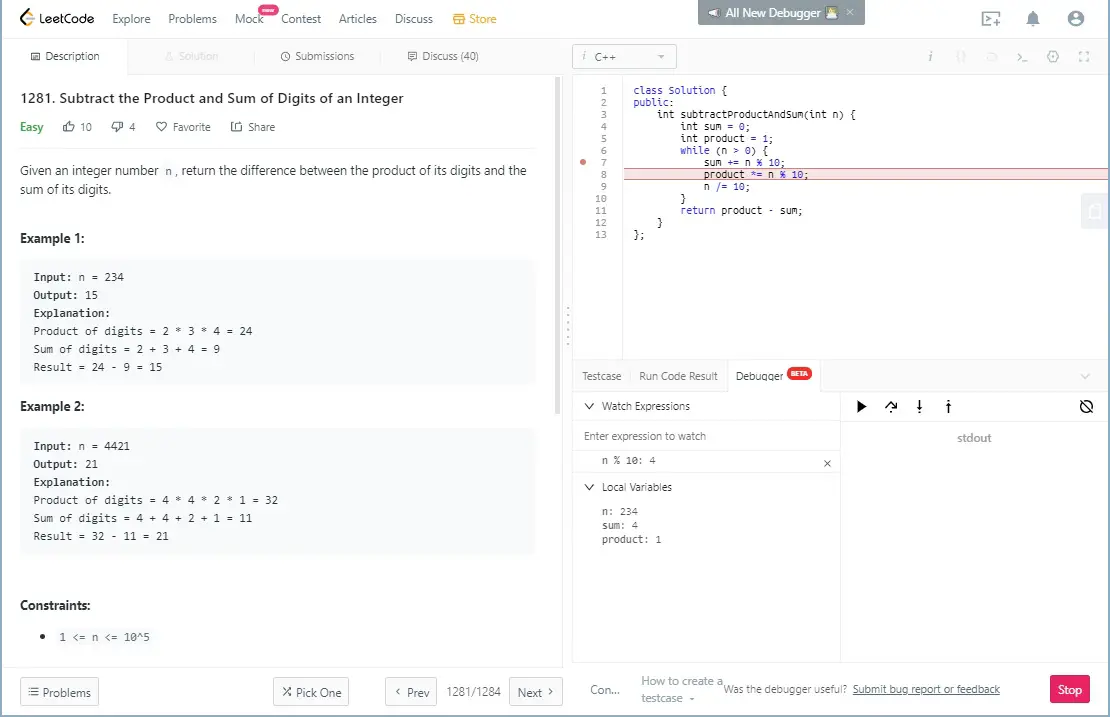
leetcode-debugger
To get the digits of a integer, we can iteratedly divide the integer by ten, and retrieve the right-most digit by using modulous operator (%). The time complexity is O(lgN).
class Solution {
public:
    int subtractProductAndSum(int n) {
        int sum = 0;
        int product = 1;
        while (n > 0) {
            sum += n % 10;
            product *= n % 10;
            n /= 10;
        }
        return product - sum;
    }
};
The C++ code above requires O(1) constant space. And in Python, you could convert the integer into string, join them with a space, then split them into array of digit strings, finally convert them into list of digits by using the map function.
from operator import mul
from functools import reduce

class Solution:
    def subtractProductAndSum(self, n: int) -> int:
        temp = list(map(int, ' '.join(str(n)).split()))
        return reduce(mul, temp, 1) - sum(temp)
Then, we can compute the produce by using the reduce function, with the mul operator. The sum of digits can be just obtained via the sum() function.
–EOF (The Ultimate Computing & Technology Blog) —
Last Post: Leetcode's Online Code Debugger and Intelligent Code Completion
Next Post: Microbit Programming: Introduction to AI - Letting Computer Play the Game