
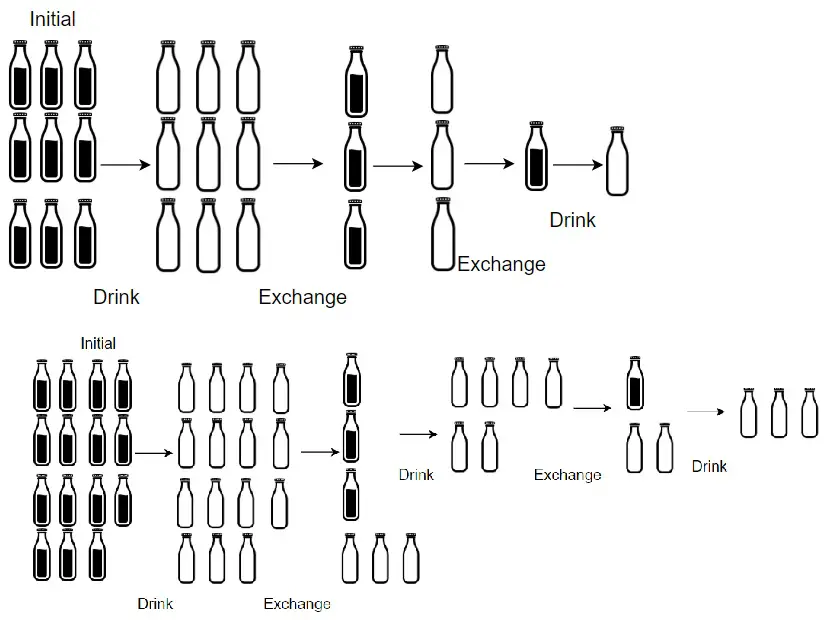
Given numBottles full water bottles, you can exchange numExchange empty water bottles for one full water bottle. The operation of drinking a full water bottle turns it into an empty bottle. Return the maximum number of water bottles you can drink.
simulation-algorithm-water-bottles
Example 1:
Input: numBottles = 9, numExchange = 3
Output: 13
Explanation: You can exchange 3 empty bottles to get 1 full water bottle.
Number of water bottles you can drink: 9 + 3 + 1 = 13.Example 2:
Input: numBottles = 15, numExchange = 4
Output: 19
Explanation: You can exchange 4 empty bottles to get 1 full water bottle.
Number of water bottles you can drink: 15 + 3 + 1 = 19.Example 3:
Input: numBottles = 5, numExchange = 5
Output: 6Example 4:
Input: numBottles = 2, numExchange = 3
Output: 2Constraints:
1 <= numBottles <= 100
2 <= numExchange <= 100
Exchanging Bottles Simulation Algorithm
This is a classic problem to apply the simulation algorithm. If empty bottoes are enough for a exchange, we keep doing this until we can’t exchange for a single bottle. The pitfall is that we have to add the remainder to the next rounds’ emtpy counters.
class Solution:
    def numWaterBottles(self, numBottles: int, numExchange: int) -> int:
        ans = numBottles
        empty = numBottles
        while empty >= numExchange:
            newBottles = empty // numExchange
            ans += newBottles
            empty = newBottles + empty % numExchange
        return ans
C/C++/Java-style solutions are like:
class Solution {
    public int numWaterBottles(int numBottles, int numExchange) {
        int ans = numBottles;
        int empty = numBottles;
        while (empty >= numExchange) {
            int newBottles = empty / numExchange;
            ans += newBottles;
            empty = newBottles + empty % numExchange;
        }
        return ans;
    }
}
–EOF (The Ultimate Computing & Technology Blog) —
Last Post: Using CloudFlare Worker Serverless Technology to Deploy a Load Balancer (RPC Node) for Steem Blockchain
Next Post: Remove the Temporary Files (including Windows.old) on Windows 10 to Save Space via Storage Sense