What is Impermanent Loss?
Impermanent Loss (IL) is a unique risk in the field of decentralized finance (DeFi). It primarily occurs when liquidity providers (LPs) supply assets to automated market maker (AMM) platforms such as Uniswap or SushiSwap.
- Impermanent loss (IL) occurs when the relative price of assets in a liquidity pool changes compared to when they were deposited.
- It represents a loss compared to simply holding the assets directly.
What Causes Impermanent Loss?
Impermanent loss arises due to the relative price change of assets within a liquidity pool. When LPs deposit two assets into a liquidity pool, the proportion of these assets dynamically adjusts to maintain a constant product (e.g., in Uniswap v2, 

Example
- Initial state: Deposit 1 ETH and 100 USDT (assuming 1 ETH = 100 USDT).
- Price change: ETH price increases to 1 ETH = 150 USDT.
- Rebalancing: The pool adjusts the ratios to maintain the constant product formula

- Withdrawal: You withdraw approximately 0.82 ETH and 123 USDT, worth

- Direct holding value:

- Difference: Impermanent loss is



Key Characteristics
- Impermanence: If the price returns to its original state, the impermanent loss disappears, which is why it is termed “impermanent.”
- Magnitude depends on price changes: The larger the price fluctuation, the greater the impermanent loss.
- Offset by Fees: The trading fees earned by LPs (e.g., 0.3%) may offset or even exceed the impermanent loss.
Formula
- Estimate IL using the formula:

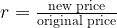
- When

- When


How to Mitigate Impermanent Loss
- Choose Low-Volatility Asset Pairs: Provide liquidity to pools with stable assets (e.g., USDC/USDT) to reduce impermanent loss.
- Earn Higher Fees: Participate in active pools with high trading volumes to earn fees that can offset the loss.
- Consider Alternative Protocols: Some protocols (e.g., Balancer or Curve) allow asymmetric liquidity provision, which can reduce risks further.
Impermanent loss is a critical risk for liquidity mining in DeFi. Understanding its effects and strategies to mitigate it is essential before participating.
Why Can’t Impermanent Loss Be Negative?
Impermanent loss is always measured against directly holding the assets:
- Reduction in asset quantity: Due to the constant product formula (e.g.,

- Value difference: The total value of the adjusted asset pair in the pool is lower than the value of holding the original asset pair directly. Thus, it only results in a loss, never in “negative loss” or additional gains.
A Common Misunderstanding: Offsetting Loss with Fees
While impermanent loss itself cannot be negative, liquidity providers can earn trading fees, which might offset or even completely cover the loss. In some cases:
- Trading fees > Impermanent loss: The overall net profit is positive.
- However, this does not mean “impermanent loss becomes negative” — it is the trading fees that make up the difference.
The math and mechanics of impermanent loss make it impossible for it to be negative. However, strategic actions (e.g., selecting low-volatility asset pairs and pools with high trading volumes) can ensure that the overall profit remains positive, effectively reducing the impact of impermanent loss on earnings.
Blockchain Web3 Technology
- TRON (TRX) and Huobi (HTX) could be the next 100x tokens
- Introduction to Impermanent Loss
- Crypto Token Exchange Rate Computation Based on Breadth First Search Algorithm on Poloniex API
- Crypto is Just the Tip of the Blockchain Iceberg
- Blockchain Hardfork vs Soft-fork
- Layer 1 and Layer2 in Blockchain Technology
- Introduction to Shielded Contracts on Blockchain (EVM, TVM)
- How to Fix "Returned Error: replacement transaction underpriced" when Sending the ETH on Ethereum Blockchain?
- Blockchain and Web3.0 Interview Questions
- Integrating ChatGPT Prompt AI to STEEM blockchain
- When is Next Bitcoin Halving?
- dApps Scalability Challenges (Distributed Apps)
–EOF (The Ultimate Computing & Technology Blog) —
Last Post: Ionomy Exchange Has Absconded with Investors' Coins
Next Post: Teaching Kids Programming - Butterfly Theorem in Quadrilateral (Geometry)