In [here], two equations are used and compare the efficiency of computation of the math constant 

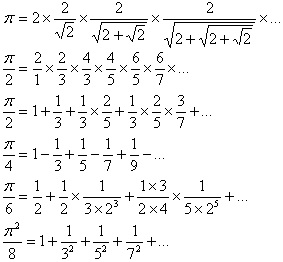

We pick the third one and multiple by two on both sides of the equations.


And, similar to [here], we use the following Python script to see how this equation converges.
#!/usr/bin/env python
# https://helloacm.com

from math import *

EPSILON = 0.001
step = 0
ans = 2
z = 2
a = 1.0
b = 3

while 1:
    z = z * a / b
    ans += z
    a += 1
    b += 2
    step += 1
    if abs(pi - ans) <= EPSILON:
        break
    print step, ans, abs(pi - ans)
This gives the quickest convergence among the three.
1 2.66666666667 0.474925986923
2 2.93333333333 0.208259320256
3 3.04761904762 0.0939736059707
4 3.09841269841 0.0431799551771
5 3.1215007215 0.0200919320891
6 3.13215673216 0.00943592143306
7 3.13712953713 0.00446311646026
8 3.13946968065 0.00212297294364
9 3.14057816968 0.00101448390946
Only 9 iterations are required to reach a accuracy of 0.001. We use builtin native types (precision of double), the accuracy is limited. We can use arrays to hold the results with a higher number of digits. We can stimulate the process of computation. The following is a Python script that uses arrays (long arithmetic) to compute the
#!/usr/bin/env python
# https://helloacm.com

def compute(len):
    x = [0] * len
    z = [0] * len
    x[1] = z[1] = 2
    a = 1; b = 3
    while True:
        # z *= a
        d = 0
        j = len - 1
        while j > 0:
            c = z[j] * a + d
            z[j] = c % 10
            d = c / 10
            j -= 1
        # z /= b
        d = 0
        for j in xrange(len):
            c = z[j] + d * 10
            z[j] = c / b
            d = c % b
        # x += z
        run = 0
        j = len - 1
        while j > 0:
            c = x[j] + z[j]
            x[j] = c % 10
            x[j - 1] += c / 10
            run |= z[j]
            j -= 1
        if not run:
            break
        a += 1
        b += 2
    return "".join(map(str, x))

if __name__ == "__main__":
    print compute(1000)

0314159265358979323846264338327950288419716939937510582097494459230781640628620899862803482534211706798214808651328230664709384460955058223172535940812848111745028410270193852110555964462294895493038196442881097566593344612847564823378678316527120190914564856692346034861045432664821339360726024914127372458700660631558817488152092096282925409171536436789259036001133053054882046652138414695194151160943305727036575959195309218611738193261179310511854807446237996274956735188575272489122793818301194912983367336244065664308602139494639522473719070217986094370277053921717629317675238467481846766940513200056812714526356082778577134275778960917363717872146844090122495343014654958537105079227968925892354201995611212902196086403441815981362977477130996051870721134999999837297804995105973173281609631859502445945534690830264252230825334468503526193118817101000313783875288658753320838142061717766914730359825349042875546873115956286388235378759375195778185778053217122680661300192787661119590921638728
–EOF (The Ultimate Computing & Technology Blog) —
Last Post: The Simple Tutorial to Disjoint Set (Union Find Algorithm)
Next Post: Codeforces: B. Internet Address