In [here], the basic 0/1 knapsack is discussed. For each item, you can choose to put or not to put into the knapsack. Therefore, for the number of items, there are only two options: 0 or 1.
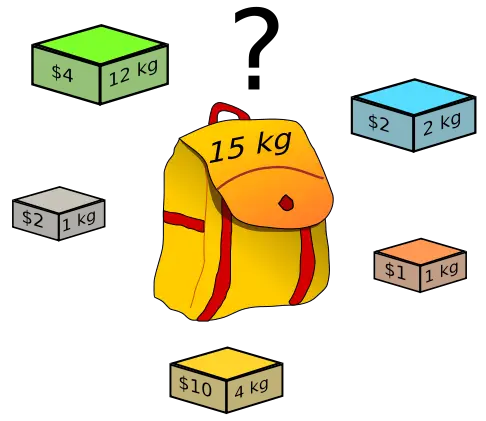

In Complete Knapsack Problem, for each item, you can put as many times as you want. Therefore, if capacity allows, you can put 0, 1, 2, 
>



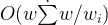
Similar to 0/1 Knapsack, there are O(WN) states that need to be computed. However, for the 0/1 knapsack, the complexity of solving each state is constant. The Complete Knapsack needs 


One greedy optimisation is to replace items of heavier-but-less-valuable items with ones of lighter-more-valuable. If 


Another straightforward transform to 0/1 Knapsack Problem is to consider the maximum number of times for item i to put is 

The other better transform is to split item i to items that have weights 






Knapsack Problems
- Teaching Kids Programming - 0/1 Knapsack: Length of the Longest Subsequence That Sums to Target (Recursion+Memoization=Top Down Dynamic Programming)
- Teaching Kids Programming - 0/1 Knapsack Space Optimised Dynamic Programming Algorithm
- Teaching Kids Programming - Using Bottom Up Dynamic Programming Algorithm to Solve 0/1 Knapsack Problem
- Teaching Kids Programming - 0/1 Knapsack Problem via Top Down Dynamic Programming Algorithm
- Teaching Kids Programming - Multiple Strange Coin Flips/Toss Bottom Up Dynamic Programming Algorithm (Knapsack Variant)
- Teaching Kids Programming - Multiple Strange Coin Flips/Toss Top Down Dynamic Programming Algorithm (Knapsack Variant)
- Teaching Kids Programming - Max Profit of Rod Cutting (Unbounded Knapsack) via Bottom Up Dynamic Programming Algorithm
- Teaching Kids Programming - Max Profit of Rod Cutting (Unbounded Knapsack) via Top Down Dynamic Programming Algorithm
- Teaching Kids Programming - Brick Layout (Unlimited Knapsack) via Bottom Up Dynamic Programming Algorithm
- Teaching Kids Programming - Brick Layout (Unlimited Knapsack) via Top Down Dynamic Programming Algorithm
- Count Multiset Sum (Knapsacks) by Dynamic Programming Algorithm
- Count Multiset Sum (Knapsacks) by Recursive BackTracking Algorithm
- Dynamic Programming Algorithm to Solve the Poly Knapsack (Ubounded) Problem
- Dynamic Programming Algorithm to Solve 0-1 Knapsack Problem
- Classic Unlimited Knapsack Problem Variant: Coin Change via Dynamic Programming and Depth First Search Algorithm
- Classic Knapsack Problem Variant: Coin Change via Dynamic Programming and Breadth First Search Algorithm
- Complete Knapsack Problem
- 0/1 Knapsack Problem
- Teaching Kids Programming - Combination Sum Up to Target (Unique Numbers) by Dynamic Programming Algorithms
- Algorithms Series: 0/1 BackPack - Dynamic Programming and BackTracking
- Using BackTracking Algorithm to Find the Combination Integer Sum
- Facing Heads Probabilties of Tossing Strange Coins using Dynamic Programming Algorithm
- Partition Equal Subset Sum Algorithms using DFS, Top-Down and Bottom-up DP
–EOF (The Ultimate Computing & Technology Blog) —
Last Post: How Programmer Reads Your CV?
Next Post: The Simple Tutorial to Disjoint Set (Union Find Algorithm)