Question: You are climbing stairs. It takes n steps to get to the top. Each time, you can take 1 step or 2 steps. How many distinct ways to get to the top?
Problem Description: http://oj.leetcode.com/problems/climbing-stairs/
This problem may look difficult at first, but when you think for a second, you might find it so easy. The answer is Fibonacci Numbers (see here, here)
Well, the original Fibonacci Numbers are defined as sequences:

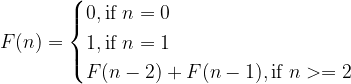
For this problem, we just have to modify a little bit:


The rest is as Fibonacci series. The 

You can use recursion, but this can be solved by a more effective iterative solution.
class Solution {
public:
    int climbStairs(int n) {
        if (n == 1) return 1;
        if (n == 2) return 2;
        // f(n) = f(n - 1) + f(n - 2)
        int a = 1, b = 2, c = a + b;
        for (int i = 3; i <= n; i ++) {
            c = a + b;
            a = b;
            b = c;
        }
        return c;
    }
};
Or you prefer a more straightforward recursive function:
class Solution {
public:
    int climbStairs(int n) {
        if (n == 1) return 1;
        if (n == 2) return 2;
        return climbStairs(n - 1) + climbStairs(n - 2);
    }
};
Note: The recursive will yield TIME LIMIT EXCEEDED on test 44. That is because, the recursive function usually computes intermediate values many many times. For example, 



–EOF (The Ultimate Computing & Technology Blog) —
Last Post: Coding Exercise - First Missing Positive - C++ - Online Judge
Next Post: How to Check If Two Binary Trees are the Same?