On Windows Operating System, the PE executables have file extension ending with *.exe and the DLL (Dynamic Link Library) end with *.dll. If you right click the property, and you will find the version number.

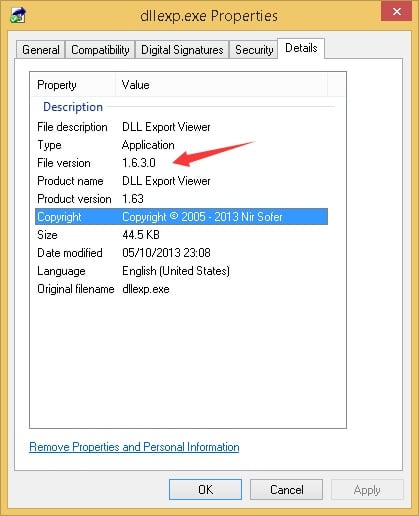
file-version
So, to obtain this string (version) during runtime, we can use Win32 APIs GetFileVersionInfoSizeA, GetFileVersionInfoA and VerQueryValueA
int GetFileVersion(const char *filename, char *ver)
{
    DWORD dwHandle, sz = GetFileVersionInfoSizeA( filename, & dwHandle );
    if ( 0 == sz )
    {
        return 1;
    }
    char *buf = new char[sz];
    if ( !GetFileVersionInfoA( filename, dwHandle, sz, & buf[ 0 ] ) )
    {
        delete[] buf;
        return 2;
    }
    VS_FIXEDFILEINFO * pvi;
    sz = sizeof( VS_FIXEDFILEINFO );
    if ( !VerQueryValueA( & buf[ 0 ], "\\", (LPVOID*)&pvi, (unsigned int*)&sz ) )
    {
        delete[] buf;
        return 3;
    }
    sprintf( ver, "%d.%d.%d.%d"
            , pvi->dwProductVersionMS >> 16
            , pvi->dwFileVersionMS & 0xFFFF
            , pvi->dwFileVersionLS >> 16
            , pvi->dwFileVersionLS & 0xFFFF
    );
    delete[] buf;
    return 0;
}
Please also note that the GetFileVersionInfoSizeW, GetFileVersionInfoW and VerQueryValueW are the unicode-versions and you should use const wchar_t* filename to pass the unicode file path.
As pointed out, to free the dynamic buffers, we need to use delete [] instead of delete – which will cause memory leaks.
–EOF (The Ultimate Computing & Technology Blog) —
Last Post: How to Decode Hardware ID by VMProtect (using VBScript) ?
Next Post: How to Make Printer a Fax using Epson Connect ?