Bash Programming is Powerful and of course it is fun as well. Today, we are going to do a simple exercise in BASH programming: checking a string if it is a palindrome or not. A palindrome is a string that its reverse version is exactly the same. For example, “ABBA” and “ABCBA” are palindromes but “ABCD” and “ABCDE” are not.
An empty string and any single characters are palindromes by default. Let’s take a closer look at the following script namely check_palindrome.
#!/bin/bash

isPalindrome() {
        local s=$1
        local len=${#s}
        for (( i=0;i<len/2;i+=1 )); do
                if [[ ${s:i:1} != ${s:len-i-1:1} ]]; then
                        return 1 # false
                fi
        done
        return 0 # true
}

for word in "$@"; do
        isPalindrome $word
        if [[ $? -eq 0 ]]; then
                echo $word
        fi
done
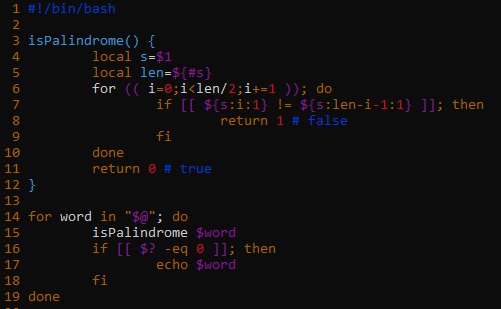
bash-function-check-string-is-palindrome
We use the following syntax to define a function in BASH script:
function_name() {
  # function body goes here.
}
And we use local to declare local variables. The $(#variable) is used to get the length of the given string variable. We use the following for loop to iterate the first half indices:
for (( i=0;i<len/2;i+=1 )); do
  # check character at [i] and [len-i-1]
done
We use ${s:i:1} to retrieve the character at position i of string s i.e. s[i]. Then we need to compare the characters s[i] and s[len-i-1] that is a palindrome is mirrored by itself.
If at anytime we see a mismatch, we use return 1 to exit a bash function and give it a 1 value which means FALSE. Otherwise, after the loop ends, we return 0 which stands for TRUE.
We use:
for word in "$@"; do
   # parameter is iterated as $word
done
to iterate over the command line arguments in BASH script. Then, we call our palindrome function. And then, we check the return value from the function by using $?. If the return value is ZERO, we output the palindrome string.
Example usages:
$ ./check_palindrome abc abba abcd 12321
abba
12321
$
If you are given line-by-line strings to check in a text file, then we can use the following:
$ cat words.txt
abc
abba
abcd
12321
$ for i in $(cat words.txt); do
  ./check_palindrome $i
done
abba
12321
$
You can see BASH is indeed a truly powerful programming language: where there is a shell, there is a way!
–EOF (The Ultimate Computing & Technology Blog) —
506 wordsLast Post: Algorithm to Find Duplicate Files in System using Hash Map
Next Post: Learn to Stay Cool in Online Casinos and Control Emotions