The problem is from codeforces: http://www.codeforces.com/problemset/problem/125/B
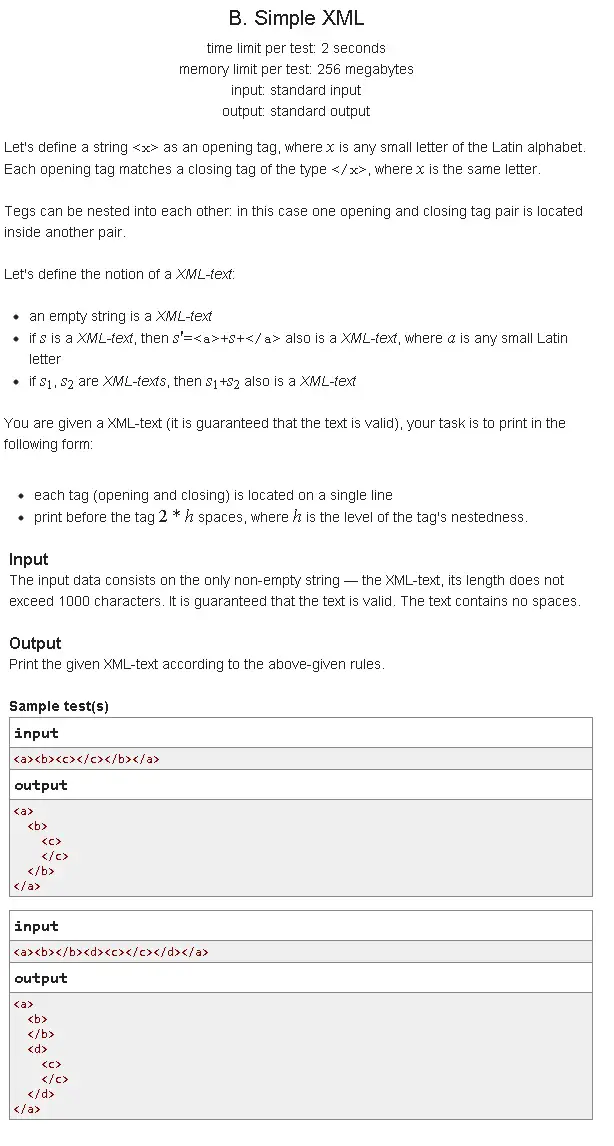

The given input has no format errors, which makes it easy to solve because you don’t have to consider unregular situations such as tags are not nested correctly. I think most of the algorithms have to consider two cases, the starting tag “<a>” and ending tag “</a>”. For each starting tag, you increase the lvl by one, and for each ending tag, you decrease the level by one.
To print 2 * h number of spaces, in Python, you can use the built-in operations “*”, for example,
print "abc" * 4
gives the output abcabcabcabc
The straightforward implementation in Python is given below.
#!/usr/bin/env python

from sys import *

s = stdin.readline()

i = 0
j = len(s)
lvl = 0
while i < j:
    c = s[i]
    if c == '<':
        if s[i + 1] == '/':
            i += 1
            k = i + 1
            while s[k] != '>':
                k += 1
            tag = s[i + 1: k]
            lvl -= 2
            print " " * lvl + "
The short description of the algorithm shown above is analyse each tag “<a>” or “</a>” respectively. It is noted that the alternative to read from stdin other than raw_input() is using sys.stdin.readline(), as shown in the code.
However, using Regular expressions re in Python gives a much shorter code.
import re
l=0
for q in re.findall('.*?>',raw_input()):l-=q<'<0';print" "*l*2+q;l+=q>'<0'
The problem statements says that there is no space in the given input, therefore, you might also split the input by the delimiter “><“:
text = raw_input()[1:-1].split("><")

s = 0
for tag in text:
    if tag[0] == '/':
        s -= 1
        tag = tag[1:]
        print "%s</%s>"% ('  ' * s, tag)
    else:
        print "%s<%s>" % ('  ' * s, tag)
        s += 1
It is interesting to find that using Python, you can write many accepted solutions that look differently, and in just a few lines of code.
–EOF (The Ultimate Computing & Technology Blog) —
Last Post: Codeforces: A. Theatre Square
Next Post: Command Line Arguments in Python Script