The Fibonacci numbers are defined as the following sequence, with the current item is the sum of the previous two items.
F(1) = 0
F(2) = 1
F(N) = F(N – 1) + F(N – 2) for N >= 3
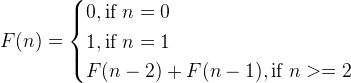
Fibonacci Equation
The first few Fibonacci numbers are: 0, 1, 1, 2, 3, 5, 8, 13, 21…
Of course, it is trivial to write a loop to sum the Fibonacci numbers of first N items.
function sumOfFib(n) {
  let a = 0;
  let b = 1;
  let sum = 0;
  for (let i = 1; i < n; ++ i) {
     let c = a + b;
     a = b;
     b = c;
     sum += a;
  }
  return sum;
}
Let’s define the S function the sum of first few Fibonacci numbers:
S(1) = F(1) = 0
S(2) = F(1) + F(2) = 1
S(3) = F(1) + F(2) + F(3) = 2
S(4) = F(1) + F(2) + F(3) + F(4) = 4
S(5) = F(1) + F(2) + F(3) + F(4) + F(5) = 7
…
We notice that


For example:
S(4) = F(6) – 1 = 5 – 1 = 4
S(3) = F(5) – 1 = 3 – 1 = 2
Using Induction to Prove the Fibonancci Sum Formula
S(1) = 0
S(2) = 1
Assume S(N) = F(N+2) – 1 stands.
S(N+1) = S(N) + F(N+1)
= F(N+2) + F(N+1) – 1
= F(N+3) – 1
And it also works for N+1!
Cancel Out the Fibonacci Numbers
We can rewrite the Fibonacci Formula as F(N) = F(N + 2) – F(N + 1).
Therefore, 
= F(2) – F(1) + F(3) – F(2) + F(4) – F(3) + …. F(N + 2) – F(N + 1)
Intermediate items are canceled out:
= F(N + 2) – F(1) = F(N + 2) – 1
How cool is that!

–EOF (The Ultimate Computing & Technology Blog) —
Last Post: Algorithm to Multiply Two Big Integers (String)
Next Post: Flashing the BIOS of HPZ800 Server to 3.61 Rev.A