The problem is from codeforces: http://www.codeforces.com/problemset/problem/26/A
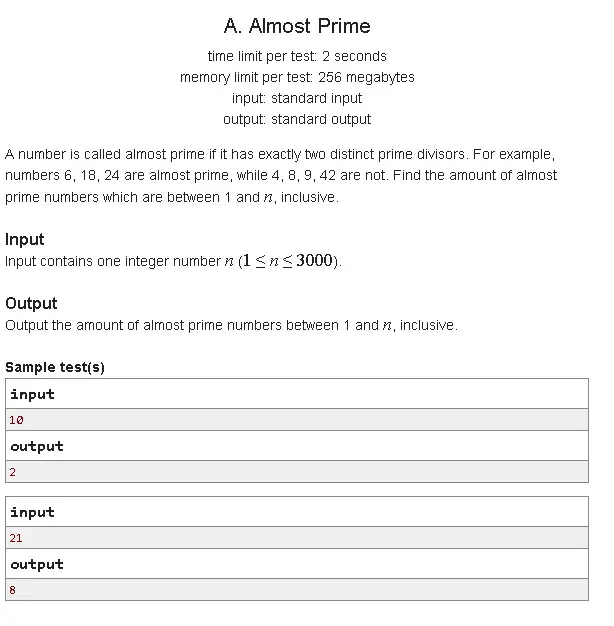

The input range is small which means even the worst brute-force methods can pass the test. The straightforward implementation is 

The Python solution is presented, which solves the problem within 220 ms.
#!/usr/bin/env python
# https://helloacm.com
n = int(raw_input())

def chk(n):
    i = 2
    j = 0
    k = 1
    while n > 1:
        u = n % i == 0
        if u:
            while n > 1:
                n /= i # divisor extraction
                if n % i > 0:
                    break
        if i == 3:
            k = 2 # skip even numbers
        i += k
        if u:
            j += 1
            if j > 2: # can't be almost prime
                return False
    return j == 2

s = 0
for i in xrange(6, n + 1):
    if chk(i):
        s += 1

print s
–EOF (The Ultimate Computing & Technology Blog) —
Last Post: Newton Iterative Sqrt Method
Next Post: E, base of the natural logarithm